1 min read
The $0 Statement of Work: what a free offer taught me about why AI adoption really stalls
Last month we took price off the table entirely. Nothing sped up.
2 min read
Paul Heaton : Aug 13, 2026, 3:51:32 PM
The most impressive IT team I've met recently doesn't have a managed service provider. It might need one anyway — just not the kind you're thinking of.
Picture the setup: a lean internal team of developers and administrators running an all-Microsoft environment at 99-point-something per cent in-house. A genuinely mature data practice — Power BI reports numbering in the hundreds, with dedicated staff behind them. These are not people who need help patching servers. By every traditional measure, they're the organisation that made MSPs unnecessary.
And yet, when we talked about AI, three problems surfaced that all their capability couldn't touch.
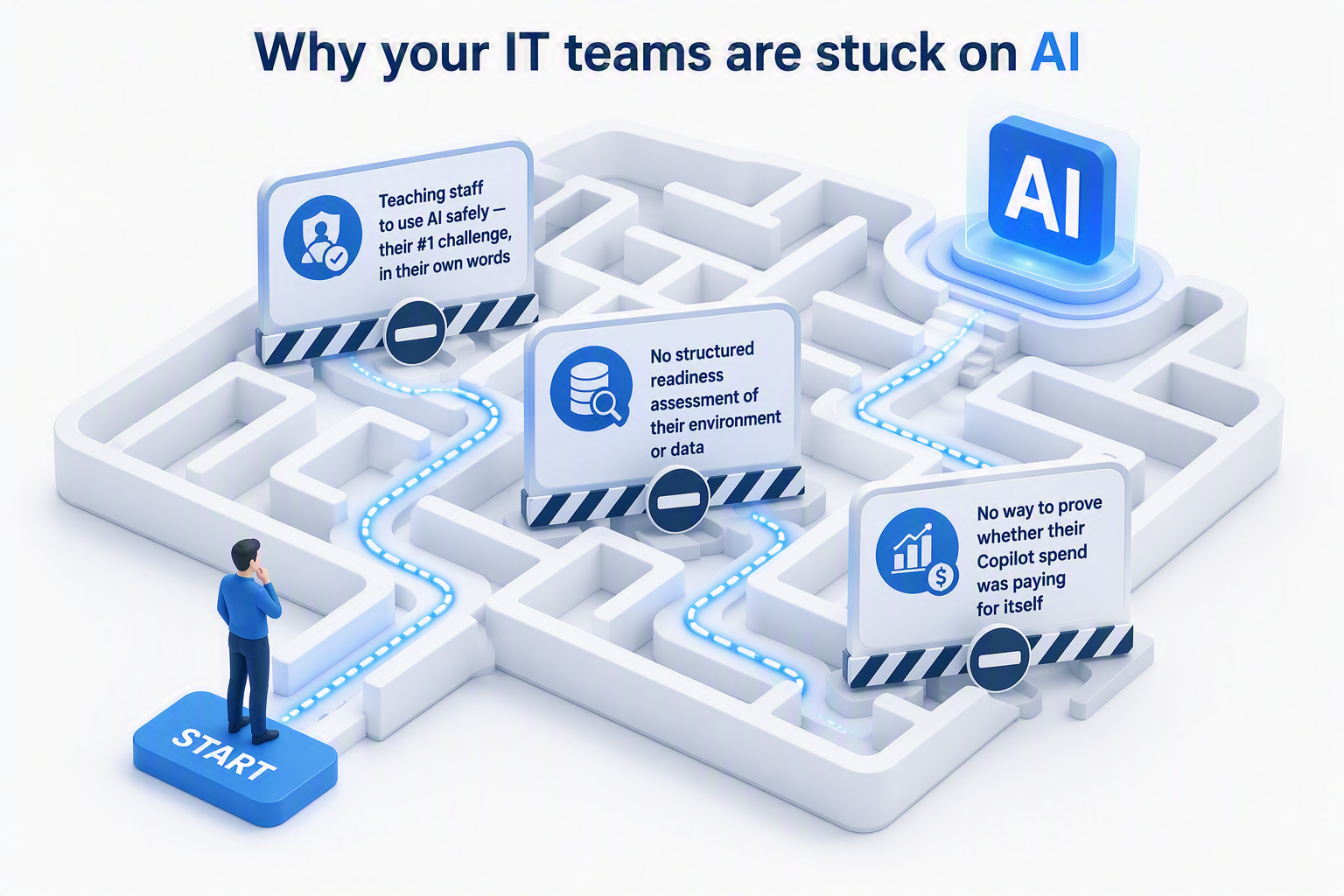
They couldn't answer the education question. Their single biggest challenge, in their own words, was helping staff use AI safely and appropriately. Not deploying it — governing the humans around it.
They couldn't answer the readiness question. No structured assessment of whether their environment and data landscape were actually ready for AI, despite the team being more than capable of running one — because running one for yourself is a different discipline from running your systems.
They couldn't answer the money question. Paid Copilot licences for some staff, free Copilot chat for everyone, other AI tools among the developers — and no confident way to demonstrate whether any of it was paying for itself.
Here's the paradox: this team could build almost anything. What they couldn't do was prove, govern and teach. And that's not a criticism of them — it's the shape of the new problem.
For twenty years, the logic of managed services was straightforward: if you had a capable internal team, you didn't need us. Infrastructure could be self-served. AI breaks that logic, because the hard parts of AI aren't technical. Safe-use education is a change-management problem. Governance is an accountability problem. ROI proof is a measurement problem. These are organisational challenges wearing a technology costume, and technical skill doesn't transfer to them — if anything, a strong technical team is more likely to assume it's handled, which is exactly how it doesn't get handled.
The data says this isn't one organisation's story. In Australia, roughly two-thirds of workers now use AI at work — and more than half of those are using tools their employer never provided or approved. Only about 30% of organisations have a formal policy governing generative AI, and barely a quarter of workers say their leadership is clearly aligned on AI strategy. The workforce is ahead of the organisation almost everywhere — including, perhaps especially, in the organisations with the strongest IT teams, because capable people adopt capable tools fastest.
So, if you lead one of these organisations, the question isn't "is our IT team good enough?" They almost certainly are. The question is whether "good at technology" is the capability this problem actually calls for — or whether what you need now is help with judgement: what to allow, what to measure, what to teach, and how to prove the spend.
That's a different kind of partner than the one you decided years ago you didn't need. You can self-serve servers. Judgement — at least at first, and at speed — is harder to self-serve.
Source:
1. 67% of Australian workers use AI at work; 56% of those use unapproved tools; ~30% of organisations have a formal genAI policy; 28% say leadership is aligned on AI strategy — roi.com.au/blog/stats/ai-usage-adoption-statistics-in-australia-2026, attributing Salesforce/YouGov (May 2026) and Microsoft Work Trend Index (June 2026).
1 min read
Last month we took price off the table entirely. Nothing sped up.
1 min read
Australian organisations have spent the past two years experimenting with artificial intelligence. New tools have appeared at speed, pilots have...
1 min read
As you Intune administration was first released with his own portal (known as Silverlight portal), then has been integrated to the Azure...