1 min read
4 min read
What Changes When AI Becomes Part of Everyday Work
Chrissy Brown : Oct 19, 2026, 2:20:44 PM
Christine Brown, Head of AI Transformation & Strategic Programs at cubesys, on building our first production agent, getting people to actually use it, and what ISO/IEC 42001 asked of us.
Eighteen months ago, AI at cubesys was mostly a better search engine. People used it to find information and build their skills, and before long to draft emails and basic content. Useful, but it was not changing how we worked. Everyone used AI in their own way, nothing was shared across the business and we could see we were stagnating. So we stepped back and asked how we could do better.
Our First Production Agent
The first real change came from our knowledge library. When we looked honestly at how we documented the way cubesys operates, we found gaps. We mapped it out properly last year, then quickly realised AI could not read that first version as well as we needed it to. So the team built SystemsAtlas, which is two agents: one creates and one advises. The creating agent builds our documentation from different sources, including our meeting transcripts, and turns it into a knowledge library. The advising agent gives our staff an easy way to find what they need. It was the first agent we took into production at cubesys, and building it gave us the process we now use to create agents for ourselves and for our customers. Then nobody used it.
Getting People to Use It
People went back to what they knew, which was asking their preferred colleague. Knowledge travelled by word of mouth, and that leaves gaps and interrupts other people's work. What worked was finding AI champions in each business unit. These are the everyday users of your technology, the people doing the work every day, and usually the ones who are already helpful in their teams. We asked them to show colleagues how to use the agent. When someone asked them a question, they would answer with a screenshot from Systems Advisor, and eventually they would simply say: ask Systems Advisor. The second thing that matters is security. When people know a tool has been adopted with compliance, security and governance in mind, they are far more likely to use it. Once the guardrails are in place and people know the business has taken care of that for them, they stop worrying and start innovating.
What Is Still Not Right
Alongside Systems Atlas we introduced Cowork across the business, then ran an internal campaign where everyone, from our technology team through administration, finance, marketing and sales, built a shared library of skill files. It worked. People produced high-quality documents faster and shared the results across teams. It also created a new problem. Skills, like agents, need to stay current, and we found people were not always using the latest version. We are now taking a more controlled approach to versioning our skills and agents, so they comply with our AI management system and everyone has the best version available. That is iterative work, and I expect it always will be.
Who Owns an Agent
At cubesys an agent owner is not automatically a manager or a head of department. It is the person who knows what the agent is meant to do, uses it and is responsible for the people relying on its output. The owner works with the developers to set the agent up, keeps its output consistently high quality and works through each new iteration with them. The aim is simple: save our people time without letting quality slip.
When a Person Steps In
We call it a human handoff, and we decide where it happens when we design the agent, in its AI Contract. The contract holds the agent's instructions along with the guardrails and security that keep it on task. Some agents need one handoff and others need several, depending on what they produce and what they can access. An agent we are developing now to create project timelines has three. First, a person confirms it is working on the right project with the right internal and customer teams, so its reasoning starts from the correct data. Second, a person reviews the draft before it is saved to our SharePoint library. Third, a project manager checks the quality before anything reaches the customer.
What ISO/IEC 42001 Asked of Us
In plain terms, ISO/IEC 42001 is the international standard for how an organisation manages AI. To meet it, every part of your AI management system has to be considered, mapped out and actually followed. That includes training, so everyone in the business knows the processes and procedures. We did not want something bolted on for the audit. We already held ISO 27001 for information security and ISO 9001 for quality, within what we call our integrated management system, so we evolved that to include AI. The hardest part was range. Our customers run from small businesses with a handful of users to enterprise and government, so our approach had to be light enough for the first and scalable enough for the second. Is it all overhead? No. Because we use these systems every day, they are part of how we operate. It is in our DNA.
What I Changed My Mind About
I started like most of our people, using AI for research and drafting. What changed was Cowork. It became exactly that, a coworker. It summarises my previous week of chats and emails, drafts my responses, helps me prioritise, reviews what I produce, prepares me for meetings and builds documents and presentations. AI is no longer an app I open from time to time. It is part of my whole working day.
Three Things to Sort Out Before You Build
We had failures early on: agents that did not work, or could not produce consistent output. We were building agents before some of today's tools existed, and treating ourselves as the customer meant we learned those lessons before any customer had to. Here is what I would sort out first.
- Write the work down. If your knowledge is not documented in a way AI can read, an agent cannot help.
- Name the owner and the handoffs before you build. Decide who is accountable and where a person steps in.
- Plan for adoption, not just delivery. Find your champions and show people the guardrails are there. What would you like an AI agent to do for your business? Let us explore it together
1 min read
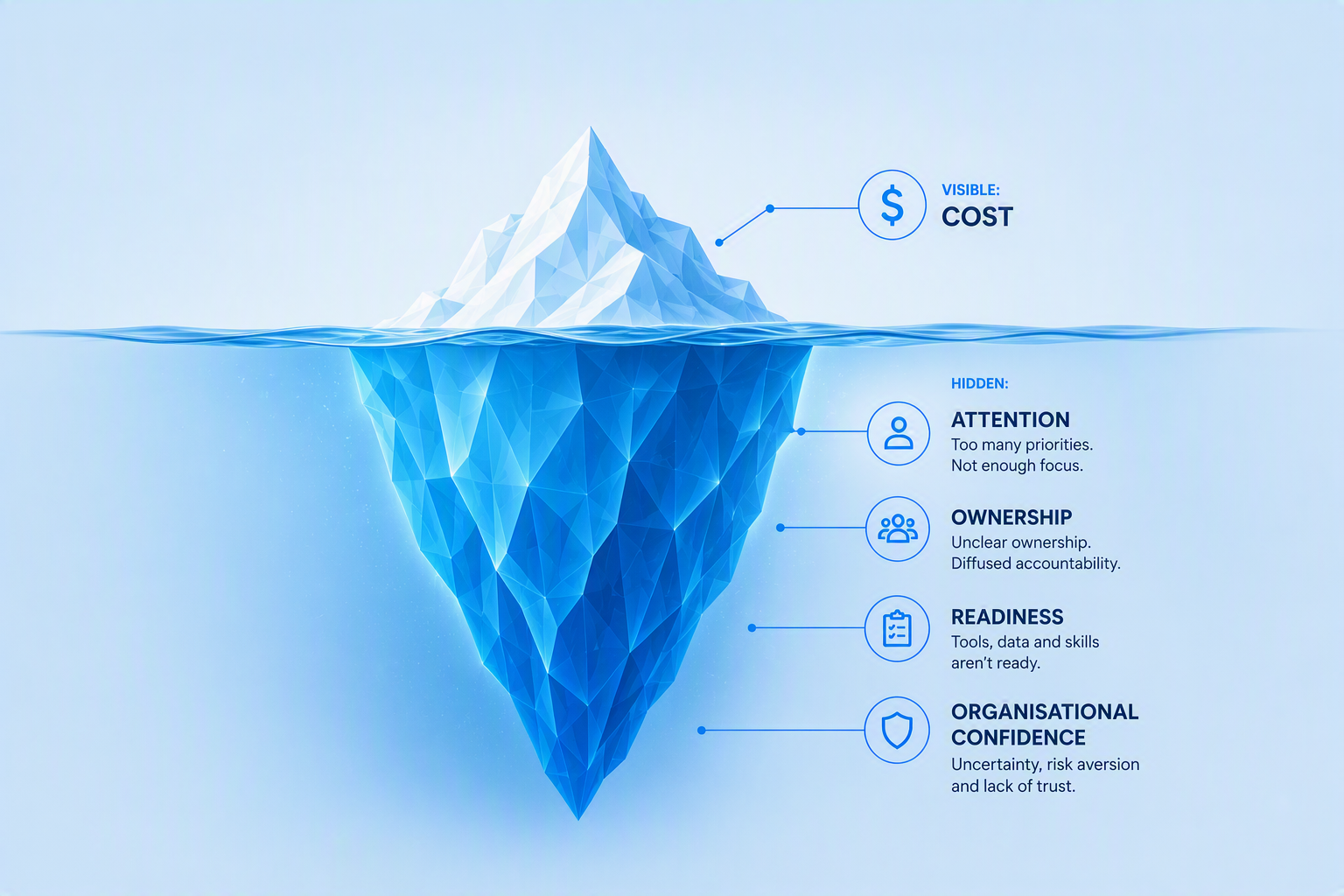
The $0 Statement of Work: what a free offer taught me about why AI adoption really stalls
Last month we took price off the table entirely. Nothing sped up.
1 min read